Culture
Incredible India

It is impossible not to be astonished by India’s incredible diversity. Nowhere on Earth does humanity present itself in such a dizzying, creative burst of cultures and religions, races and languages. Every aspect of the country presents itself on a massive, exaggerated scale, worthy in comparison only to the superlative mountains that overshadow it. Perhaps the only thing more difficult than to be indifferent to India would be to describe or understand India completely.
Location, Geography & Climate

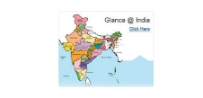
Set apart from the rest of Asia by the supreme continental wall of the Himalayas, the Indian subcontinent touches three large bodies of water and is immediately recognizable on any world map. This thick, roughly triangular peninsula defines the Bay of Bengal to the east, the Arabian Sea to the west, and the Indian Ocean to the south.
India's 29 states hold virtually every kind of landscape imaginable. An abundance of mountain ranges and national parks provide ample opportunity for eco-tourism and trekking, and its sheer size promises something for everyone.
North India

North India, shaped like a throat and two lungs, is the country's largest region. It begins with the panhandle of Jammu and Kashmir, a dynamic area with terrain varying from arid mountains in the far north to the lake country and forests near Srinagar and Jammu. Falling south along the Indus river valley, the North becomes flatter and more hospitable, widening into the fertile plains of Punjab to the west and the Himalayan foothills of Uttar Pradesh and the Ganges river valley to the east. Cramped between these two areas is the capital city, Delhi. The southwestern extremity of the North is the large state of Rajasthan, whose principal features are the Thar Desert (external website, opens in a new window) and the stunning "pink city" of Jaipur. To the southeast is southern Uttar Pradesh and Agra, home of the famous Taj Mahal (external website, opens in a new window).
West India
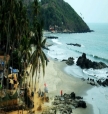
West India contains the states of Gujarat, Maharashtra, Goa, and part of the massive, central state of Madhya Pradesh. The west coast extends from the Gujarat peninsula down to Goa, and it is lined with some of India's best beaches. The land along the coast is typically lush, with rainforests reaching southward from Mumbai all the way into Goa. A long mountain chain, the Western Ghats, separates the verdant coast from the Vindhya mountains and the dry Deccan plateau further inland.
East India

Some of the revered Ganges river and the majority of Himalayan foothills, East India begins with the states of Madhya Pradesh, Bihar and Odisha, which comprise the westernmost part of the region. East India also includes the North-East, an area known as the eastern triangle, which is entirely distinct. This is the last gulp of land that extends beyond Bangladesh, culminating in the Naga Hills along the Burmese border.
South India

India reaches its peninsular tip with South India, which begins with the Deccan in the north and ends with Cape Comorin, where Hindus believe that bathing in the waters of the three oceans will wash away their sins. The states in South India are Karnataka, Telangana, Andhra Pradesh, Tamil Nadu, and Kerala, a favorite leisure destination. The southeast coast, mirroring the west, also rests snugly beneath a mountain range—the Eastern Ghats.
Climate
Because of India's size, its climate depends not only on the time of year, but also the location of the place you want to visit. In general, temperatures tend to be cooler in the north, especially between September and March. The south is coolest between November and January. In June-July, winds and warm surface currents begin to move northwards and westwards, heading out of the Indian Ocean and into the Arabian Gulf. This creates a phenomenon known as the south-west Monsoon, and it brings heavy rains to the west coast. Between October and December, a similar climatic pattern called the north-east Monsoon appears in the Bay of Bengal, bringing rains to the east coast. In addition to the two monsoons, there are two other seasons, spring and autumn.
People, Religion & Culture
Languages and Diversity
Despite the varied cultural tapestry that India presents, there are deep cultural continuities that tie its people together. English and Hindi are the major languages of trade and politics, but there are twenty-two official languages in all. There are twenty-four languages that are spoken by a million people or more, and countless other dialects. India has seven major religions and many minor ones, six main ethnic groups, and countless holidays.
Religion
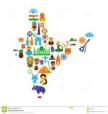
Religion is central to Indian culture, and its practice can be seen in virtually every aspect of life in the country. Hinduism is the dominant faith of India, serving about 80 percent of the population. About 14 percent worship Islam, and 6 percent are Sikhs, Christians, Buddhists, Jains, Baha'is, and more.
Festivals

India, being a multi-cultural, multi-ethnic and multi-religious society, celebrates holidays and festivals of various religions. In addition, many Indian states and regions have local festivals depending on prevalent religious and linguistic demographics. Popular religious festivals include Navratri, Janmashtami, Diwali, Ganesh Chaturthi, Durga Puja, Holi, Onam, Ramzan, Bakrid, Christmas, Easter and Rakshabandhan. Apart from these, there are harvest festivals such as Lohri, Pongal, Makar Sankranti, Bihu, etc.
Art of Dance

India has had a long romance with the art of dance. Indian dance includes eight classical dance forms, many in narrative forms with mythological elements. The eight classical forms accorded classical dance status by India's National Academy of Music, Dance, and Drama are: Bharatanatyam of the state of Tamil Nadu, Kathak of Uttar Pradesh, Kathakali and Mohiniyattam of Kerala, Kuchipudi of Andhra Pradesh, Yakshagana of Karnataka, Manipuri of Manipur, Odissi of the state of Odisha and the Sattriya of Assam.
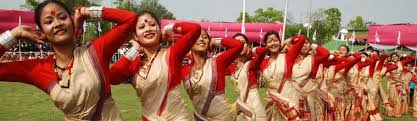
In addition to the formal arts of dance, Indian regions have a strong free-form, folk dance tradition. Some of the folk dances include the Bhangra of Punjab; the Bihu of Assam; the Zeliang of Nagaland; the Chhau of Jharkhand and Bengal, in addition to many others.
We welcome you to experience the richness of Indian culture, traditions, cuisine and arts.